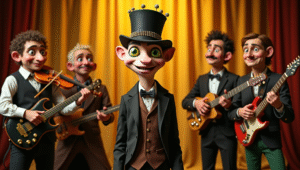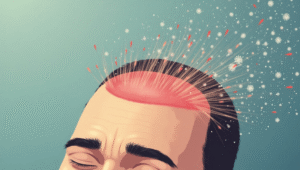

Miss Amplification doesn’t enter a room; she calibrates it. She gives the radiator a speaking part and the wallpaper a backstory. A teaspoon becomes percussion. A passing look becomes a headline. If the world is a radio, she’s forever nudging the dial until every station plays hypersensitivity.
The Day, Turned Up
I used to think I was “too much” for ordinary minutes. Now I think the minutes are simply too sharp for my edges. Some days the gain is set high, and Miss Amplification is already taking notes.
Vacant Space 1
This is where heightened sensitivity reactions can feel both clever and costly: the mind spots patterns fast, but it also flinches at harmless noise. It’s a heightened reaction to stimuli that makes ordinary life feel like it has subtitles, a soundtrack, and an opinionated narrator. For those who want a broader, non-prescriptive overview of how sensory processing can differ from person to person, the National Autistic Society offers a clear, human explanation of sensory processing differences without turning lived experience into a checklist.
Miss Amplification’s Tea Party
This little gathering belongs firmly in my wider habit of playful observation — the same spirit that runs through my collection of nonsense verse and joyful gems, where noticing too much is half the point.
Miss Amplification brewed a cup of sky,
 And asked the kettle, “Please don’t cry.”
 The carpet whispered, “Mind your feet,”
 The doorway hummed a tired beat.
A sock declared, “I’m far too brave,”
 A spoon said, “I will not behave.”
 The lamp performed a silent sneeze,
 The curtains practised gentle bees.
A biscuit sighed, “I’m crumbly, dear,”
 A clock announced, “The end is near.”
 The chair took offence at being sat,
 The doormat judged the neighbour’s cat.
So hypersensitivity stayed for tea,
 And filed the noises A to Z.
Type 1 hypersensitivity: The Startle-Sprint Strategy
When this shows up, Miss Amplification treats it like a fire drill: quick, noisy, urgent. Her favourite tactic is “name the moment.” Not to fix it — just to notice it. That one-second pause can stop my over-responsive sensory system from sprinting ahead of the facts. It reminds me of the way sudden sensations once took centre stage in Pins and Needles: Sir Prickalot Endures, where urgency arrived long before explanation.
What is a hypersensitivity, according to Miss Amplification?
For me, what is a hypersensitivity is not a badge or a verdict; it’s a mismatch between input and comfort. It’s when the world feels like it has turned the treble up and forgotten where the off-switch lives.
Miss Amplification’s second tactic is to soften the stage: fewer interruptions, gentler light, and small routines that reduce surprise. Done kindly, those same heightened sensitivity reactions become easier to carry.
Type 2 hypersensitivity: The Over-Interpretation Notebook
Here, Miss Amplification becomes an editor. She circles words, underlines facial expressions, and adds footnotes to silence. The “power tactic” is to downgrade meaning. I remind myself: “A sigh is a sigh, not a prophecy.” That’s how I dial back an excessive sensory response before it becomes a whole novel. That editorial instinct — circling meaning where none was intended — echoes the mood I explored in Dysesthesia: A Tale of the Dismal Dame, where sensation and interpretation refused to stay in their lanes.
There’s humour in it too. My over-responsive sensory system can detect sarcasm at twenty paces, yet sometimes misses the obvious: I’m tired. So the next tactic is permission — permission to be boring, to sit, to stop patrolling the room like a security guard.
Type 3 hypersensitivity: The Slow-Build Static
With this one, nothing explodes; everything accumulates. A bright screen. A crowded shop. A day of “fine, fine, fine.” Then the static becomes a wall. Miss Amplification’s tactic here is to reduce friction early — fewer tabs open, fewer decisions, fewer “just one more” tasks — so the excessive sensory response doesn’t stack up into a tower. I’ve noticed that rhythm and routine matter here, much like the quiet cadence behind Rhyming the Wahls Protocol, where steadiness matters more than speed.
And yes, this can still be a heightened reaction to stimuli — just slower, sneakier, and harder to spot until it’s already moved the furniture in your head.
Type 4 hypersensitivity reactions: The Delayed Punchline
These arrive late, like a joke you understand on the bus home. Examples of type 4 hypersensitivity often look like a delayed flare of annoyance or discomfort after an earlier contact or encounter — my body filing a complaint after the meeting has ended. The tactic is simple: expect the echo, and leave room for a gentler evening if the day was spiky.
And, for the record, type 1 hypersensitivity reactions aren’t the only ones that feel immediate; sometimes anticipation is the loudest sound in the room.
Conclusion: Keeping Miss Amplification on a Shorter Lead
Miss Amplification still notices everything. She just doesn’t get to run the whole show. On hypersensitivity days I keep the toolkit small: pause, soften, simplify, and let the volume settle. When I do that, the headline shrinks, and the day becomes liveable again.
“Joy isn’t a reward for finishing the work; it’s proof you chose the right kind.”
Stephenism
🎵 Soul from the Solo Blogger — Tunes from Túrail.