

Have you ever woken up feeling as though your energy has already been spent? Perhaps you have plans for the day, but your body has other ideas. For someone living with a chronic illness, even seemingly ordinary activities can demand an extraordinary amount of effort.
This is where the term spoonie comes into its own.
A spoonie is someone who identifies with spoon theory, a metaphor used to explain the experience of living with limited energy because of chronic illness or disability. It gives people a simple way to describe something that can otherwise be remarkably difficult to communicate.
For those of us living with multiple sclerosis (MS), the metaphor can feel particularly familiar.
But spoon theory is about much more than feeling tired. It is about choices, priorities, uncertainty and learning to recognise the limits of the energy available to us.
What Does Being a Spoonie Mean? 7 Insights into Everyday Life
The term comes from The Spoon Theory, a personal essay written by Christine Miserandino to explain her experience of living with lupus.
In her explanation, spoons represent a limited supply of energy. Every activity costs a certain number of spoons, and once they have been used, there may be little or nothing left for the rest of the day.
You can explore the concept further in WebMD’s explanation of spoon theory .
The metaphor offers a useful starting point for understanding the relationship between chronic illness and everyday activities.
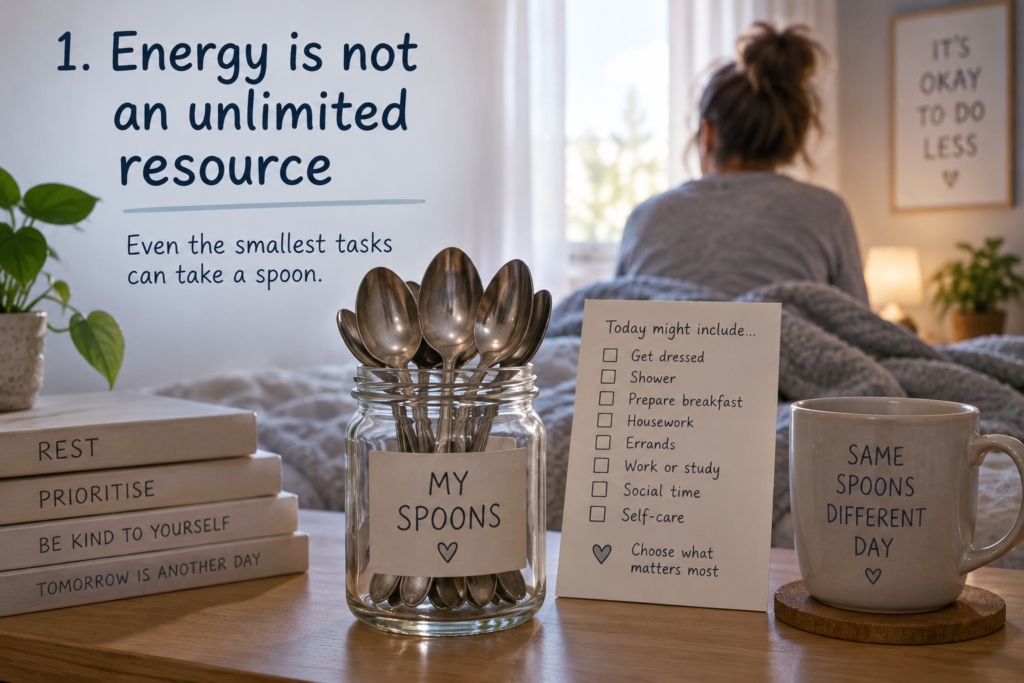
1. Energy is not an unlimited resource
For many people, getting dressed, preparing breakfast and leaving the house are simply parts of a morning routine.
For a spoonie, those same activities may consume a substantial proportion of the day’s available energy.
Living with chronic illness and limited energy means recognising that seemingly small tasks can have unexpectedly large consequences.
2. Every decision has an energy cost
Imagine waking up with ten metaphorical spoons.
Showering might cost two. Preparing breakfast another. A trip to the supermarket could consume several more.
Suddenly, a relatively ordinary morning has left very little energy for the afternoon.
The numbers are illustrative rather than scientific, but they make an important point: decisions that appear trivial to others may require considerable thought.

3. Invisible disabilities create everyday challenges
One of the difficulties of living with an invisible condition is that other people cannot necessarily see the effort involved.
Someone might appear perfectly well while sitting in a café, yet reaching that café may have required an enormous amount of energy.
Invisible disabilities and everyday challenges are closely connected because outward appearances rarely tell the whole story.
A person might decline an invitation, leave a gathering early or cancel arrangements at short notice.
These decisions are not necessarily a reflection of their enthusiasm or willingness to participate.
Sometimes, the spoons simply aren’t there.

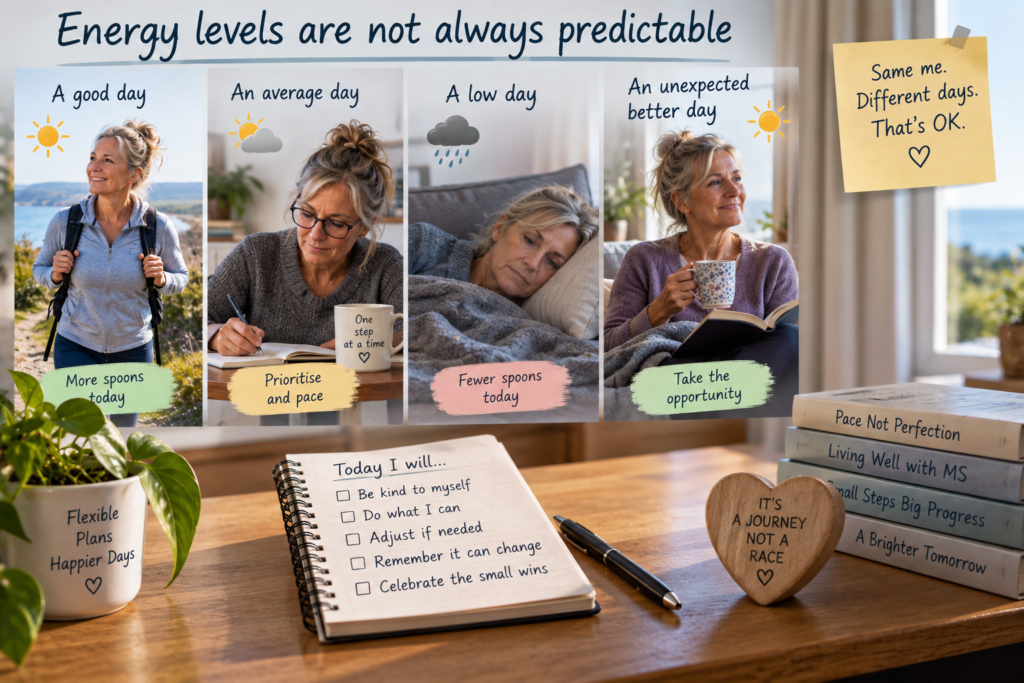
4. Energy levels are not always predictable
One limitation of the metaphor is that it can suggest we begin every morning with a fixed and measurable allocation.
My experience of MS has taught me that life is rarely so accommodating.
Some mornings are better than others. Occasionally, an activity that seemed manageable yesterday feels overwhelming today.
Spoon theory provides a language for describing these fluctuations without pretending that energy can be measured with mathematical precision.
5. Rest is part of the equation
Being a spoonie does not mean every available moment must be spent doing something productive.
Sometimes, the most useful decision is to leave something unfinished.
A task can wait. An appointment might be rearranged. A household chore may simply have to remain undone.
This connects naturally with my approach to structuring the day to conserve energy .
The objective is not to squeeze every possible activity into the day. It is to find a workable balance between what needs doing and what feels achievable.
6. The spoonie community creates understandingHowever, not everyone with a chronic illness identifies as a spoonie. Some people find the term helpful, while others prefer different language.
The chronic illness community and shared experiences can provide something that is sometimes missing from everyday conversations: recognition.
When someone says they have run out of spoons, another person familiar with the metaphor may immediately understand.
There is no need for a lengthy explanation or justification.
However, not everyone with a chronic illness identifies as a spoonie. Some people find the term helpful, while others prefer different language.
Both approaches are equally valid. The metaphor should serve the individual, not become another label they feel obliged to adopt.

7. Limited energy does not eliminate meaningful living
Perhaps the most important insight is that having fewer spoons does not make a person’s activities, relationships or ambitions less meaningful.
It may simply change how those things are approached.
A short conversation with a friend might be more achievable than an afternoon out. Reading a few pages could replace an ambitious project.
For me, this connects with the importance of staying positive , although positivity shoulAfter all, not every day has to be a triumph to be worthwhile.d never become an obligation to pretend everything is fine.
There is room for frustration, disappointment and humour alongside optimism.

Spoon Theory and Daily Energy Management: Finding Your Own Meaning
Spoon theory is a metaphor, not a medical measurement or a universal formula for managing chronic illness.
Its usefulness lies in helping people communicate their experiences.
One person’s shower might represent a minor expenditure. For another, it could consume much of their available energy. The metaphor accommodates both experiences without suggesting that either is more legitimate.
It can also help friends and family understand why plans sometimes change, why rest matters and why apparent inactivity should not automatically be mistaken for laziness.
The metaphor is particularly useful when words such as tired or fatigued fail to convey the complexity of an individual’s experience.
Ultimately, each person decides whether spoon theory provides a useful description of their circumstances.
My final thought
Being a spoonie is not about counting your failures or measuring yourself against someone else’s capacity.
It is about finding a language that makes an often invisible experience easier to understand
Some days, there may be enough spoons for everything you planned. Other days, getting through the morning might be an achievement in itself.
Neither day defines your worth.
And perhaps the greatest value of the metaphor is that it reminds us to consider what another person might have spent simply getting to where they are.